
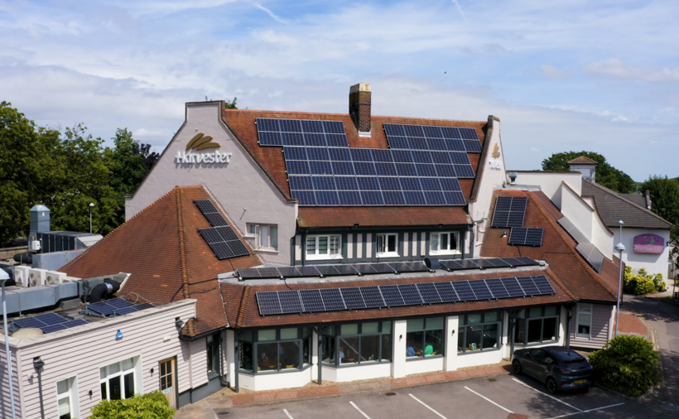
Mitchells & Butlers, the managed hospitality group behind Toby Carvery, Miller & Carter, All Bar One and Harvester, has crossed 100 sites with operational solar photovoltaic installations as it accelerates a sustainability programme anchored to a Net Zero target of 2040.
The company, which operates around 1,700 venues across the UK, has set itself a target of covering more than 200 sites with onsite solar by the end of 2025. Working with renewable energy specialist Geo Green Power, installations range from a single day for simpler rooftop arrays to five working days for larger or more complex sites.
The solar rollout sits within a broader climate strategy validated by the Science Based Targets initiative (SBTi) in January 2024 — one of the more significant sustainability benchmarks in the UK hospitality sector, requiring independently verified emissions reduction pathways rather than self-declared targets.
What the numbers show
By the close of 2024, M&B had completed 60 installations representing a combined capacity of 1,859 kilowatt-peak (kWp), with the programme expected to reduce CO2 emissions by 395 tonnes annually at that scale. The ambition is materially larger: across a 200-site deployment, the group expects each site to contribute to significant ongoing emissions avoidance as the UK grid continues to decarbonise.
The Net Zero roadmap carries firm interim milestones. By 2030, the company has committed to a 70% reduction in Scope 1 and Scope 2 emissions against a 2019 baseline — covering direct emissions from gas use and purchased electricity — alongside a 28% reduction in Scope 3 emissions, which include supply chain activity. The 2040 net zero target requires a 90% absolute reduction across all three scopes.
Progress against those targets currently stands at 16%, with the solar rollout forming one leg of a wider energy transition strategy.
Beyond the roof: kitchens and the gas question
Solar alone will not reach M&B's Scope 1 targets. The company has also electrified 74 kitchens and removed gas entirely from five sites, with the expectation that gas removal will become a more central programme priority in the years ahead.
Kitchen electrification is a significant commitment for a portfolio that includes large-format sites like Toby Carvery, where high-volume roast production has historically depended on gas. The operational shift requires capital investment in induction or electric combi equipment, retraining kitchen teams and, in many cases, upgrading site electrical supply — all of which add complexity to what might appear on paper as a straightforward infrastructure swap.
M&B has also committed to purchasing 100% renewable electricity across its estate.
Waste and broader environmental performance
The group diverts 99% of operational waste from landfill and reports a 23% reduction in food waste, with 60% of overall operational waste now recycled. Zero operational waste to landfill is the stated target for 2030.
In March 2025, Mitchells & Butlers was named Best Sustainable Pub Company at the Publican Awards, recognising the breadth of the programme across energy, waste and supply chain.
The sector context
Energy costs remain the single largest uncontrollable operating expense for most managed pub and restaurant businesses, and the strategic case for rooftop solar has strengthened considerably since 2019. Installation costs have fallen, grid electricity prices remain elevated relative to pre-2021 levels, and the reputational expectation from both consumers and institutional investors has shifted meaningfully towards demonstrable environmental action.
For operators with large, predominantly owned estate portfolios — M&B owns a significant proportion of its freeholds — the business case for solar capital expenditure is increasingly straightforward: reduced energy procurement costs, a visible sustainability credential and alignment with regulatory trends that are unlikely to soften.
The question the M&B programme raises for the wider sector is one of scale and pace. At 100 sites covered from a portfolio of approximately 1,700, the rollout is still in its early stages. Whether the 200-site target by end of 2025 represents a stepping stone or a ceiling will be one of the more closely watched sustainability benchmarks in managed hospitality over the next 12 months.